London Almanac for the year of Christ 1794

Almanacs began to be published annually in London from the 1600s but became wildly popular in the following century, were still produced into Victorian times and survive today in the form of Old Moore’s or Whitaker’s Almanack. However, the very first almanacs were produced in the second millennium BC in the Near East, providing information such as favourable and unfavourable days and how to deal with each of them.

London Almanack 1794 recently acquired for Bell House collection.

London Almanack 1794 recently acquired for Bell House collection.

Early English almanacs were sold either as a broadsheet, the precursor of the modern calendar, or as a pocket almanac like this one. They contained astronomical data such as the number of days of the full moon (useful for travelling in the days before street lighting) and used that data to produce weather forecasts which were vital for both agriculture and commerce (aiding decisions such as the movement of ships). They then began to be aimed at different groups such as farmers who got planting data, or Londoners who received municipal information such as lists of City officials and public holidays, and so they became very important to the economy.

Our example is tiny, at 3cm square it is smaller even than a matchbox. It has a burgundy leather cover with a metal clasp, although the leather flap fastener is missing. There is a metal plate under the fastener with enough space for someone’s initials, though ours is not engraved. Inside there are twenty gilt-edged leaves plus text pasted to the reverse of the front and rear marble endpapers. There is a tiny pocket inside the upper cover. 

Engraved throughout, the title page contains the arms of the livery company of Stationers with a second coat of arms on the reverse of the second leaf with a handwritten note: ‘T.W for E.W’.


The tiny almanac measuring just 3cm square.

The tiny almanac measuring just 3cm square.

The data inside includes a month by month summary of 1794 with festivals and sun/moon rising/setting times. Following this is a fascinating table of kings and queens which describes the Tudor line as ‘The families united’ and the Stuart line as ‘The union of the two crowns’. 

Details of past Lord Mayors and sheriffs follow and here Thomas Wright is represented in both lists. 

Finally we have a list of annual holidays and a table of current coins by weight. It is possible Thomas Wright printed this almanac as Wright and Gill derived a large part of their income from printing almanacs and he was an eminent member of the Stationers’ Company, for whom this almanac was printed, having been their first lord mayor for over thirty years when he was inaugurated in 1785.

Artists at Bell House

BELL HOUSE, 27 COLLEGE ROAD, DULWICH – ARTISTS’ OPEN HOUSE

13 & 14 May 2017, 11am to 6pm

PICTURE THIS…   

An exhibition of works on paper by artists who identify as being dyslexic

Curated by Kim Thornton

For the first time Bell House in Dulwich will open its doors to the public to take part in the Dulwich Festival Artists’ Open House showing work by artists who indentify as being dyslexic.  Referencing the history of the house, commissioned in 1767 by Thomas Wright a poor warehouse worker who started his own lucrative publishing business, the works from Lucy Bainbridge, Sophie Eade, Jane Higginbottom, Alice Irwin, Valeriya N-Georg and Lucy Soni will be on paper.

Both Lucy Soni and Alice Irwin throw off the constraints of the structured world drawing on children’s play and everyday chance in their work.  In contrast, Valeriya N-Georg turns to quantum physics to investigate the boundaries between the human body and the inner self.  

Lucy Bainbridge, Jane Higginbottom and Sophie Eade are all creating their own realities through their study of the environment they live in.  Lucy Bainbridge tries to pause time with her softened city prints whilst Sophie Eade eradicates urbanity and words from the magazine pages that purport to extol rural life.  Jane Higginbottom studies the environment and measures time through nature.

Bell House will also host an artist in residence in a doll’s house, The Sophie Croxton Doll House Gallery.  The project is conceived and curated by Sophie Eade and Lucy Soni. who have awarded the Picture This… residency to painter Clare Price.

The origin of the word ‘dyslexia’ comes from the German dys- ‘difficult’ and the Greek word lexis ‘speech’.  Although this difficulty with words that affects reading, spelling and writing, defines the dyslexic learning process, dyslexia is really about information processing.  People with dyslexia have a different way of thinking, often thinking in pictures rather words.  As a result they frequently have strong visual and creative skills. Click to Events for artist details.

Bell House and Dulwich Picture Gallery

Bell House has had associations with the Dulwich Picture Gallery over a long period and there were even plans to store the DPG paintings at the house during the war to protect them from bombing, although in the end other arrangements were made.  Bell House and the Gallery have been part of the Dulwich Estate for many years and the freeholds were owned by the Dulwich Estate from 1767, when Bell House was built, until 1992 when the house was sold to a private owner.

Recently the Dulwich Picture Gallery has been very energetically managed and is in the process or organising a pavilion for the summer of 2017. Bell House supported the planning application for this creative experiment and is enthusiastic about the community involvement that this will bring.

Bell House has another special link with the Gallery as the Deputy Director of the Gallery, Andrew Macdonald, was a boarder at Bell House when it was a junior boarding house for Dulwich College.  He has recently revisited and gave a graphic description of what life was like for a young boy sleeping in the dormitories and walking up to the main school for lessons and sports.

The Picture Gallery has recently appointed a new chair of trustees (Prof Evelyn Welch) and a new director - Jennifer Scott who plans to "develop the gallery as the perfect place for people to experience the inspirational potential of art."  We hope that Bell House will be able to work with the Picture Gallery to develop an appreciation for art and to provide courses that are not easily available elsewhere.   Also, events at Bell House could compliment what the Picture Gallery already does - perhaps concentrating on photography, film and local artists.  Indeed Bell House has recently organised an exhibition of local artists with themes of paper and dyslexia as part of the Dulwich Festival.     

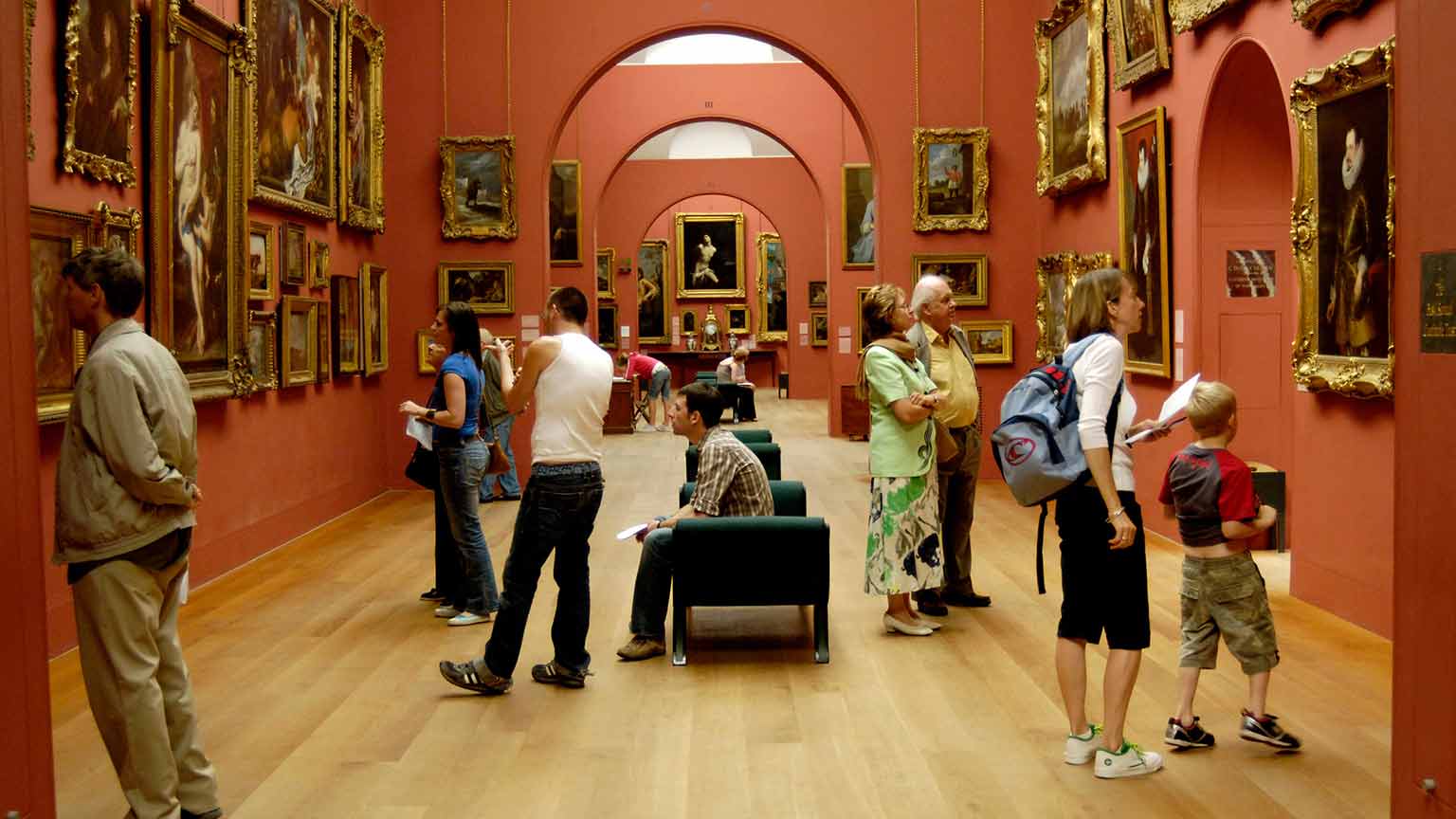
image courtesy of Dulwich Picture Gallery