Bee-keeping: an introduction

Copy of DSCF3241.jpg

The Queen Bee's behaviour may seem the ultimate in promiscuous, as she can mate with large numbers of drones.  Many of the drones in a hive don't even get the chance to mate but those that do have their genitalia torn off in the process and then die.  Having taken the drone's sperm off him the queen bee stores it in a special pouch and uses it later for when she lays eggs.  Life expectancies are different too - the queen lives for about 4 years, whereas drones live for a few months at best, and worker bees in the summer only last for about 6 weeks.  I learnt all this in the introduction to bee-keeping at Bell House Dulwich where Philip Nicholson was leading the course.

At the course I met a mix of people - an allotment holder hoping to get bees installed on their allotment,  a bee-keeper from India who is planning to set up an apiary in Forest Hill, and one young woman wanting to join the bee-keepers at Bell House as "apprentice bee-keeper number 3".  

Philip used exhibits and slides to explain the life of the bee, the bee-keeping year, diseases of the hive and how to deal with swarming.  Occasional swarms, by the way, are quite normal and are an inevitable aspect of bee-keeping as the bees try to set up new colonies.  In looking at pests and diseases, Philip told us how to counter the Varroa mite, wax moth, chalk brood, wasps and bigger animals such as mice and woodpeckers.

IMG_3949.JPG

Apart from being a terrific hobby, bee-keeping is a contribution to the environmental through pollination of flowers and trees.  For most bee-keepers a major objective is to make honey: we were told how to take off "supers" laden with honey, remove the wax capping, centrifuge out the honey and put it into jars.  Proving how productive bee-keeping is, Philip gave attendees a jar of honey which he (and his bees) have made in Kent, but next year I hope he may be able to supply honey made at Bell House in Dulwich.

If you want to know more, please email [email protected].

The Wrights Move to Dulwich

After their marriage, Thomas and Ann Wright set up home near London Bridge, close to Thomas’s business. They had three children, though only their daughter Ann survived childhood. They decided to move south, joining the exodus of families from the City which was becoming a place of business and manufacture rather than residency. The rapid improvement in roads and the building of Westminster and Blackfriars bridges enabled Thomas to commute much more easily and Dulwich, with its country air and spa at Dulwich Wells, provided an attractive alternative to the city. Commuting was a novelty as shown in this poem by Robert Lloyd written in 1757, just ten years before the Wrights moved to Bell House:

Some three or four miles out of town,
(An hour’s ride will bring you down),
He fixes on his choice abode,
Nor half a furlong from the road:
And so convenient does it lay
The stages pass it ev’ry day:
And then so snug, so mighty pretty,
To have a house so near the city!

In 1767 Thomas built Bell House and a year later replaced two ancient cottages nearby with what is now Pickwick Cottage. The eponymous bell is inscribed with the date 1770 so must have been installed a little after the house was built. In 1783 Thomas leased three more fields and the use of the mill pond on Dulwich Common with the ‘right to take fish out...by angling and no other method’. The gardens stretched to what is now the lake in Dulwich Park and also included part of Frank Dixon Close. The Wrights continued making improvements such as planting trees including perhaps the beautiful medlar tree which still stands outside the kitchen window. 
 

Lease of Bell House showing extent of garden. Source: Dulwich College

Matt rebuilds a wall

If you’ve passed Bell House recently don’t be alarmed. We are not demolishing the beautiful Georgian wall that divides the house from College Road. Part of the wall, damaged in the past, needs repairing and we are taking the opportunity to widen the entrance to allow access for emergency vehicles. Matt is undertaking the repairs and Bell House photographer Sue Robinson has taken a closer look.

DSCF0793 (1).jpg
DSCF1063.jpg
DSCF1096.jpg

Matt has carefully dismantled the wall, brick by brick, and given each brick a unique code. This careful system will allow him to reinstate the bricks in their original positions, including the blind arch.

DSCF1097.jpg

Matt has tried to save as many of the original bricks as possible but unfortunately, due to past repairs with cement mortar, many are unusable. Matt explained that mortar is the sacrificial element in masonry, it should always be weaker than the material it is binding. Cement mortar can trap moisture within the brick, causing crumbling or ‘spalling’.

DSCF1092.jpg

When Matt begins rebuilding next week (weather permitting), he will be pointing the Georgian bricks with a traditional lime mortar as it allows the brickwork a certain amount of flexibility, helping to protect them from damage. He has sourced some recycled bricks to replace those too damaged to use and will reinstate the wall including the blind arch, so that it has the same integrity as before. Soon the wall will look pretty much as it did originally. Next time you are passing, see if you can see the join.

IMG_1003 (002).JPG

Photographs by Sue Robinson

Thomas Wright, printer and paper merchant

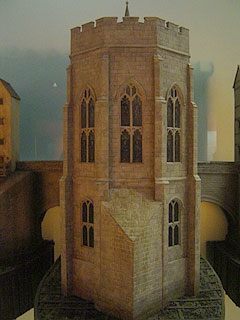
After qualifying as Master Stationer Thomas Wright and his brother-in-law William Gill opened a shop in the chapel of St Thomas à Becket in the centre of the old 12th century London Bridge. It had a lower cellar at (or under) water level which they used as a warehouse and an upper room at bridge level that served as a shop. From here they supplied paper to government departments such as the Board of Longitude which had been set up to solve the problem of finding longitude at sea.

Wright & Gill's first business premises

Wright & Gill's first business premises

Bill for the supply of paper by Wright & Gill to the Board of Longitude, 1775. Source: Cambridge Digital Library

Bill for the supply of paper by Wright & Gill to the Board of Longitude, 1775. Source: Cambridge Digital Library

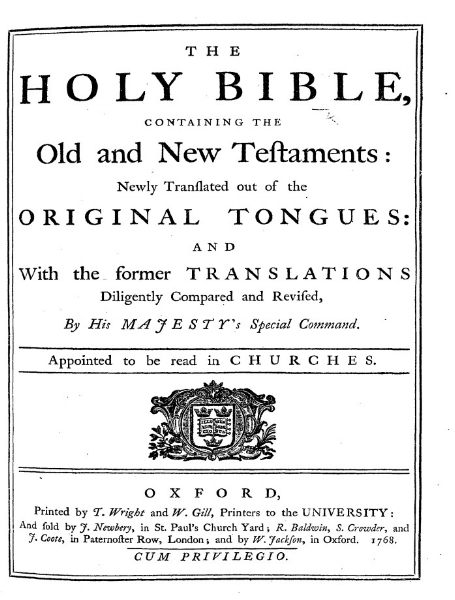
Thomas Wright’s success also stemmed from bidding for monopolies for the printing of books. He secured the right to print and sell almanacs, a highly profitable franchise. More financially rewarding still was the printing of bibles and prayer books. In 1765 he bought the monopoly to print religious works for Oxford University after the previous printer, the Baskett family, had produced books riddled with mistakes. One book had been called the ‘vinegar bible’ because the parable of the vineyard was misprinted as the parable of the vinegar. Baskett employed ‘idle and drunken staff’ and things got so bad the university had to buy their religious books from Cambridge. Thomas Wright cleverly agreed to protect the risk-averse university against any loss brought by the notoriously litigious Baskett and this helped him win the lease. 

Wright & Gill's first business premises

Since Oxford held the right to print the King James Authorised Version, this proved highly lucrative to Thomas’s firm until the American War of Independence affected their overseas market and an increase in paper costs caused them to withdraw from the lease. Many of their books survive in libraries around the world such as the British Library and the Royal Collection. Wright & Gill were the last leaseholders as the University took the work inhouse and started what became the Oxford University Press.