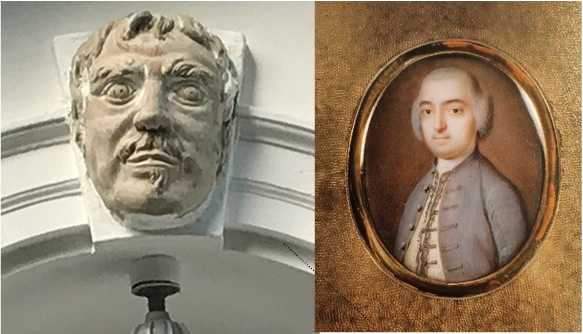
Thomas Wright, printer and paper merchant

After qualifying as Master Stationer Thomas Wright and his brother-in-law William Gill opened a shop in the chapel of St Thomas à Becket in the centre of the old 12th century London Bridge. It had a lower cellar at (or under) water level which they used as a warehouse and an upper room at bridge level that served as a shop. From here they supplied paper to government departments such as the Board of Longitude which had been set up to solve the problem of finding longitude at sea.
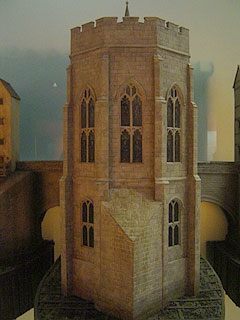
Wright & Gill's first business premises

Wright & Gill's first business premises

Bill for the supply of paper by Wright & Gill to the Board of Longitude, 1775. Source: Cambridge Digital Library

Bill for the supply of paper by Wright & Gill to the Board of Longitude, 1775. Source: Cambridge Digital Library

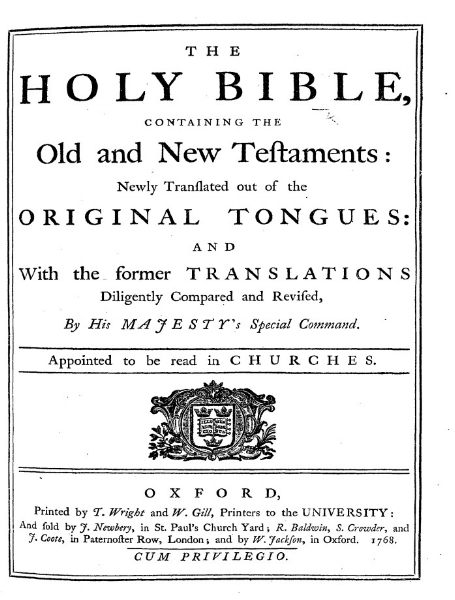
Thomas Wright’s success also stemmed from bidding for monopolies for the printing of books. He secured the right to print and sell almanacs, a highly profitable franchise. More financially rewarding still was the printing of bibles and prayer books. In 1765 he bought the monopoly to print religious works for Oxford University after the previous printer, the Baskett family, had produced books riddled with mistakes. One book had been called the ‘vinegar bible’ because the parable of the vineyard was misprinted as the parable of the vinegar. Baskett employed ‘idle and drunken staff’ and things got so bad the university had to buy their religious books from Cambridge. Thomas Wright cleverly agreed to protect the risk-averse university against any loss brought by the notoriously litigious Baskett and this helped him win the lease. 
Wright & Gill's first business premises

Since Oxford held the right to print the King James Authorised Version, this proved highly lucrative to Thomas’s firm until the American War of Independence affected their overseas market and an increase in paper costs caused them to withdraw from the lease. Many of their books survive in libraries around the world such as the British Library and the Royal Collection. Wright & Gill were the last leaseholders as the University took the work inhouse and started what became the Oxford University Press.

London Almanac for the year of Christ 1794

Almanacs began to be published annually in London from the 1600s but became wildly popular in the following century, were still produced into Victorian times and survive today in the form of Old Moore’s or Whitaker’s Almanack. However, the very first almanacs were produced in the second millennium BC in the Near East, providing information such as favourable and unfavourable days and how to deal with each of them.

London Almanack 1794 recently acquired for Bell House collection.

London Almanack 1794 recently acquired for Bell House collection.

Early English almanacs were sold either as a broadsheet, the precursor of the modern calendar, or as a pocket almanac like this one. They contained astronomical data such as the number of days of the full moon (useful for travelling in the days before street lighting) and used that data to produce weather forecasts which were vital for both agriculture and commerce (aiding decisions such as the movement of ships). They then began to be aimed at different groups such as farmers who got planting data, or Londoners who received municipal information such as lists of City officials and public holidays, and so they became very important to the economy.

Our example is tiny, at 3cm square it is smaller even than a matchbox. It has a burgundy leather cover with a metal clasp, although the leather flap fastener is missing. There is a metal plate under the fastener with enough space for someone’s initials, though ours is not engraved. Inside there are twenty gilt-edged leaves plus text pasted to the reverse of the front and rear marble endpapers. There is a tiny pocket inside the upper cover. 

Engraved throughout, the title page contains the arms of the livery company of Stationers with a second coat of arms on the reverse of the second leaf with a handwritten note: ‘T.W for E.W’.


The tiny almanac measuring just 3cm square.

The tiny almanac measuring just 3cm square.

The data inside includes a month by month summary of 1794 with festivals and sun/moon rising/setting times. Following this is a fascinating table of kings and queens which describes the Tudor line as ‘The families united’ and the Stuart line as ‘The union of the two crowns’. 

Details of past Lord Mayors and sheriffs follow and here Thomas Wright is represented in both lists. 

Finally we have a list of annual holidays and a table of current coins by weight. It is possible Thomas Wright printed this almanac as Wright and Gill derived a large part of their income from printing almanacs and he was an eminent member of the Stationers’ Company, for whom this almanac was printed, having been their first lord mayor for over thirty years when he was inaugurated in 1785.