

We're excited to launch our new quarterly newsletter. It’s a chance to share a few short stories which we hope you both enjoy and find interesting.
Read moreSeptember Monthly Garden roundup
The arrival of rain at the beginning of September was welcomed by the garden…and the gardeners! Everything in the Bell House garden really perked up after the very dry spell, and we were all kept busy with the growth explosion.
September highlights, and things to look forward to, include:
The meadow areas in both the House Garden and Walled Garden are in the process of being cut back in sections. The cuttings are left for a few days before being added to the compost bins so any insects which have been sheltering there can find a new home. Cuttings are removed to reduce nutrients being added back to the soil as meadows thrive on poor soil. Our next job will be to scarify the meadows and add yellow rattle seeds to slow the spread of grass so more wildflowers grow. We tested removing the flower heads of docks this year rather than digging them out and we will see next summer if this worked! Big thanks to everyone who worked on the meadows as it is a labour intensive job. A shout out for Jenny who put her hand up every Saturday to tackle this job.
In the Walled Garden, the tomatoes are still going strong. We know that the cooler days and nights are coming so the tomato plants have been pruned, removing the leaves so that the plants direct their energy to ripening the remaining fruit. The garlic and onions were also lifted, and after drying nicely for a couple of weeks, have been happily received by all of us gardeners 😊. We have had a new delivery of bricks so that edging around the raised beds can continue, led by the expertise of Cookie and Reg. Our new mower finally arrived so we now have two electric mowers to help manage the grass and meadow areas next year.
Staying in the Walled Garden, you’ll see some “new” tables close to the Greenhouse. When a local garden centre closed down we picked up the tables which will be adapted to use as potting and demonstration tables. Also, at that end of the garden, the raspberries which were saved from the ground source heating works have never been super happy there so will be lifted and moved to another part of the garden. This bed will then be planted with Comfrey, specifically Bocking 14 Comfrey as suggested by Shelagh. Comfrey is one of the most useful and versatile plants that can be grown – it’s a fabulous pollinator attractor, a highly effective fertiliser and apparently has potential health benefits for humans (I need to find out more about this).
Over in the House Garden, there has been a fair bit of weeding action over September – in the Rose Garden, around the arch leading to the Rose Garden and throughout all of the main beds. Our winter project will be to improve and replant the long border with more perennials and grasses. We also plan to work on the quince and rose arch, pruning the roses so that they flower lower at the sides and leaving more light and space for the quince to grow over the arch itself.
Bell House Garden will be open again on November 5th.
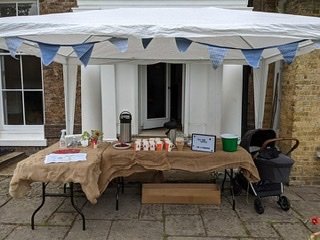
Arrive anytime between 11am and 12:45. Tea and coffee will be available. We encourage a £5 donation that will go towards garden maintenance and activities. Free tickets are also available.
September News for Gardeners
As the first September leaves start to fall and the nights become cooler, let’s reflect on the garden activities over the hot and dry Summer months.
Over in the House Garden, the Bog Garden pond has fared well. It has been a hive of wildlife activity with Damselflies and Emperor Dragonflies being spotted. The latter is a very large, impressive dragonfly - males are pale blue, with an apple-green thorax and a black stripe running the length of the body. Females are similar, but a slightly duller greeny-blue. Both are spectacular. A fact I didn’t know is that Emperor Dragonflies are a characteristic dragonfly of new ponds and, for the first few years, the larvae may be extremely common (courtesy of The Wildlife Trust). Dragonfly larvae have been spotted in our pond, in addition to water boatmen and smooth newts!
Behind the Rose garden, the meadow area has been cut in sections over the last few weeks. This is a technique used to extend the growing season of a wildflower area in the following year. I’m looking forward to seeing the results next year. Some of you may also have been lucky to have seen the leaf-cutter bees in the insect houses in this area. Check to see if they are still there the next time you are in the garden.
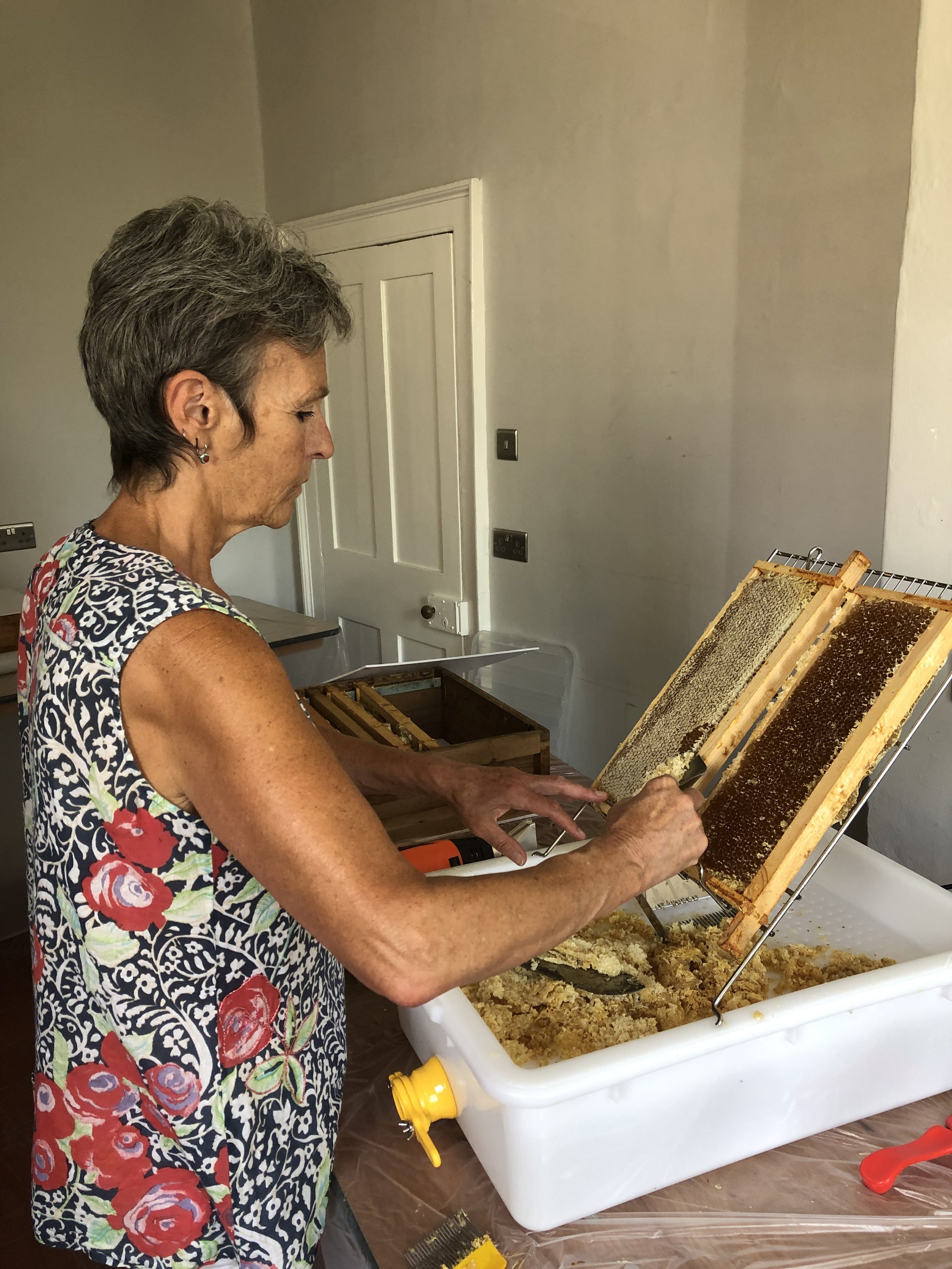
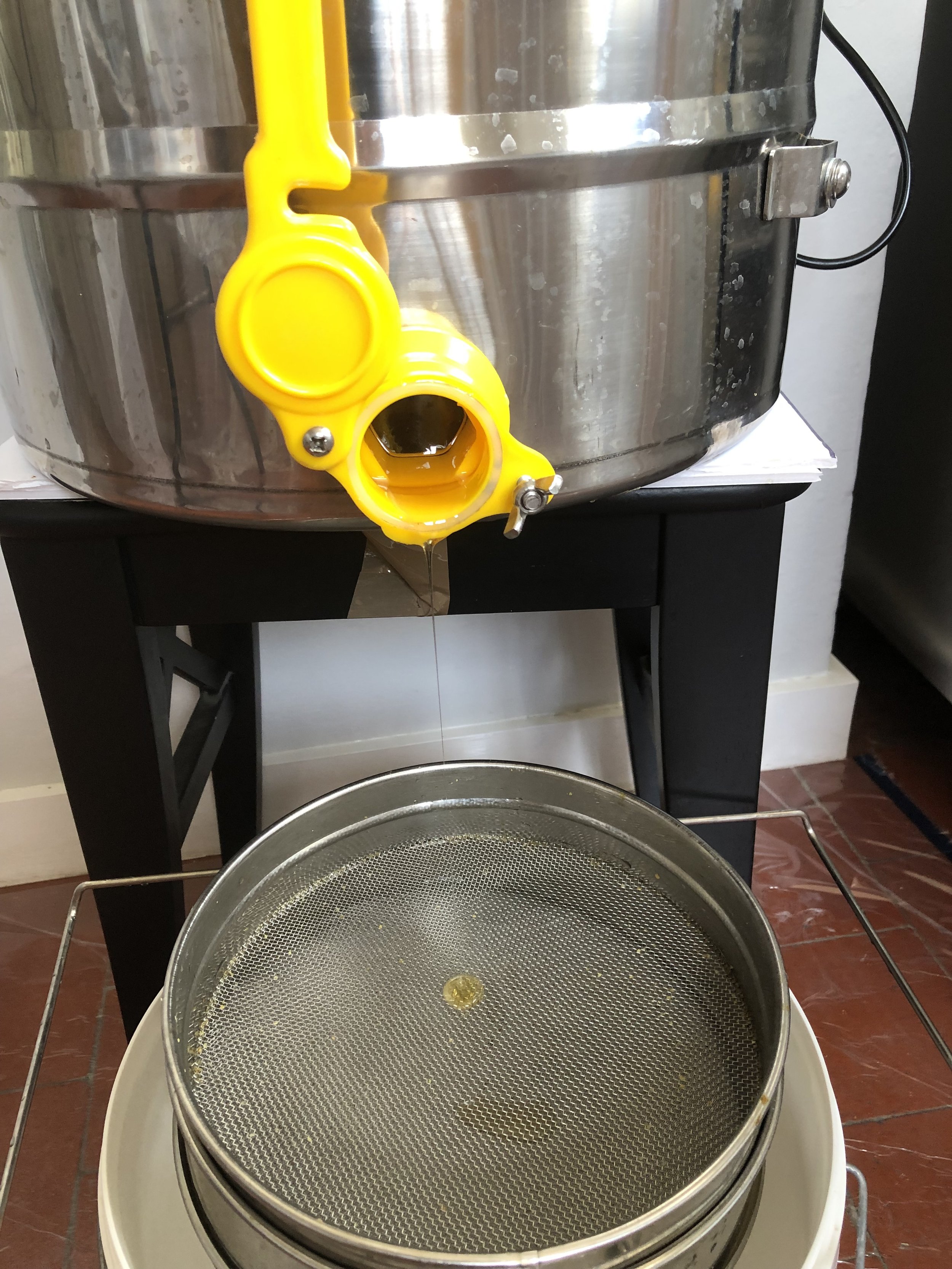
While we are on the subject of bees, Beekeeper Annie had a very busy week back in July with honey extraction in the Filmmaker kitchen. Here’s Annie removing the wax caps from the cells so that when the frames spin in the centrifuge the honey has an uninterrupted passage out of each cell and can be collected via a tap at the bottom of the centrifuge. It really is an amazing process.
Over in the Walled Garden, we have had plenty of produce over the Summer. Tomatoes and courgettes have done extremely well, as have our raspberries and beans and (for the first year I think) – aubergines 😊. We have also had success on the sweetcorn front and a special mention to the mashed potato squashes that are now coming thick and fast. There has been the odd “disappointment” and this year the winner has to be the white sprouting broccoli – all leaves and no actual broccoli heads!
Finally, the Walled Garden has given us a beautiful and colourful display of flowers this Summer. The poppies dominated in the earlier months but were soon followed by the towering verbenas and an abundance of nigella with the cosmos and rudbeckia following. Let us not forget our majestic sunflowers and exceptionally pretty morning glory and sweet peas. I am always excited to see what is blooming when I arrive in the garden.
We are very much looking forward to our Autumn time in the garden, and a big thanks to all of the hours and effort that everyone has put in over the Summer. The results are always worth it.
With thanks to the Gaynor Hayburn author of the Gardeners’ newsletter
Monthly Garden Round Up - June

Dear fellow gardeners
As we pass the summer solstice, we focus this month on the wildflowers of the Bell House garden and a summer bee experience with Beekeeper Annie.
First up, the wildflowers - over in the House garden, there have been numerous Ragged-robin found at the back of the Rose garden and close to the Bog garden and pond. This is a rare sight as wild wetland sites disappear across the UK. These moisture-loving perennials with pink, frayed flowers and star-shaped blooms attract bumblebees, dragonflies, butterflies and Honeybees. Thanks Sara for the Ragged-robin photo.
Over in the meadow in the Walled garden at the back of the vegetable beds you’ll see Crimson clover, an annual with a flower head that is a rich crimson to red colour and shaped like a cone. You’ll also spot the upright, blue flower spikes of Viper’s-bugloss that is often seen on chalk grasslands, sand dunes and cliffs. Its spotted stem is thought to resemble a viper. Another blue presence are the beautiful Cornflowers and the endangered Corncockle (now virtually extinct in the wild). Look out for its slender purple/pink flowers in our meadow. Other residents include Wild Pansy, Burdock and the Scarlet pimpernel. My favourite fact about the Scarlet pimpernel is that it is also known as “Old man’s weathervane” as the flowers close when atmospheric pressure falls and bad weather approaches.
All of these flowers are loved by our Honeybee colonies. Beekeeper Annie will be inspecting the bees and need help with honey extractions over the summer and has very kindly asked if the gardeners would be interested in these sessions. If you are, please read on!
Sessions will mostly be on a Saturday morning at 11am and last for approximately one hour (if you cannot make a Saturday then Annie may be able to run a session on a Tuesday or Thursday).
Sessions are open to all gardeners from the Tuesday, Thursday and Saturday sessions.
Two people (adults only) maximum per session (there will be one full bee suit available and one jacket/veil/gloves. Please wear boots or wellies and long trousers so all skin is covered).
Annie is not allowed to carry or administer adrenaline for anaphylactic shock so if anyone knows they are allergic they should provide their own EpiPen or not sign up for a session.
Planned summer sessions: Saturday 2 July, Saturday 9 July, Saturday 23 July, Saturday 30 July, Saturday 20 August, Saturday 10 September, Saturday 17 September and Saturday 24 September.
Please email me Annie directly ([email protected])with your preferred session and include your phone number. This will be on a first come, first served basis and Annie will email you back to confirm your session.
Please note that sessions are weather permitting. If it’s too hot then the wax is so soft that the nest may be damaged during an inspection. If it’s too cold or wet then it chills the brood and the bees need to use too much energy to get the internal temperature back up.
Big thank you to Annie for this opportunity. It feels like a real privilege and I am super excited.
Finally, the Bell House July Open Garden is on Saturday 2 July from 11.30am to 1pm. If you are free to help on the day then please email Ellie on [email protected]. It’s always a lovely day and great to see our visitors enjoying the fabulous garden, now in full bloom.
Thanks, as always, for your continued hard work in the Bell House garden.
Monthly Garden Round Up - May 2022
Dear Fellow Gardeners
I do apologise for the lateness of this newsletter. A holiday in the sun and the Platinum Jubilee got the better of me!
May was certainly a busy month in the Bell House garden, with plenty of work being carried out across our three gardening days each week. Here’s a few highlights of what we achieved:
Let’s start at the front of Bell House. The ha-ha certainly had a lot of love in early May. Any brambles that were starting to set up home were dug out, as were a number of Horse Chestnut seedlings. The ha-ha is a lovely location for bluebells and they have been a success this year, brightening up all of our days when we arrive at Bell House. More bluebells will be planted out in the ha-ha, along with geraniums.
Over in the House Garden, we let the grass grow for “No Mow May” except for a mower-wide strip around the edge of the lawn. A couple of gardening sessions were spent weeding the Rose Garden and also creating a new path across the bed close to the entrance to the Rose Garden (right next to the bird feeder). The Bog Garden planting has been a great success. Everything is growing well and looking fabulous…the photo below is my best effort but doesn’t really do it justice! Another success has been the planting of forget-me-nots under the Hornbeam, these are looking beautiful along with their iris neighbours.

In the Walled Garden, we had an exciting discovery when we were moving the compost bins around – a bumblebee nest. We’ve protected the area so we don’t disturb them, and all groups still managed to sieve lots of compost ready for the vegetable beds. Already we are getting some lovely produce including broad beans and lettuces. Courgettes have been potted on as have some of our cutting flowers - cosmos and morning glory.
Towards the end of May, many of our gardeners were able to make the first group outing together. The first order of business was lunch - a delicious picnic lunch was shared in our very own sunny Bell House garden. An NGS garden at 5 Burbage Road was then visited, where the gardeners explored the beautiful plot to gather inspiration and met the creator, the lovely Rosemary. The trip was a roaring success and we hope it is the first of many. Thank you to Ellie for organising the visit. A fruit tree expert also visited the Bell House garden in May and suggested apple, pear and soft fruit trees that we could grow. A return visit will be made in the autumn to offer fruit growing workshops for our gardening group. Definitely something to look forward to .
Finally, for those who love a few numbers, 86 gardening sessions have been completed to date this year and we have 56 volunteer gardeners. Keep up the great work!
Thanks, as always, for your continued hard work in the Bell House garden.
Gaynor