

In the 2025 Winter edition, you’ll find a selection of recent news and updates from Bell House, which we hope you will enjoy!
“No age barriers here.”
by Joan Trodden
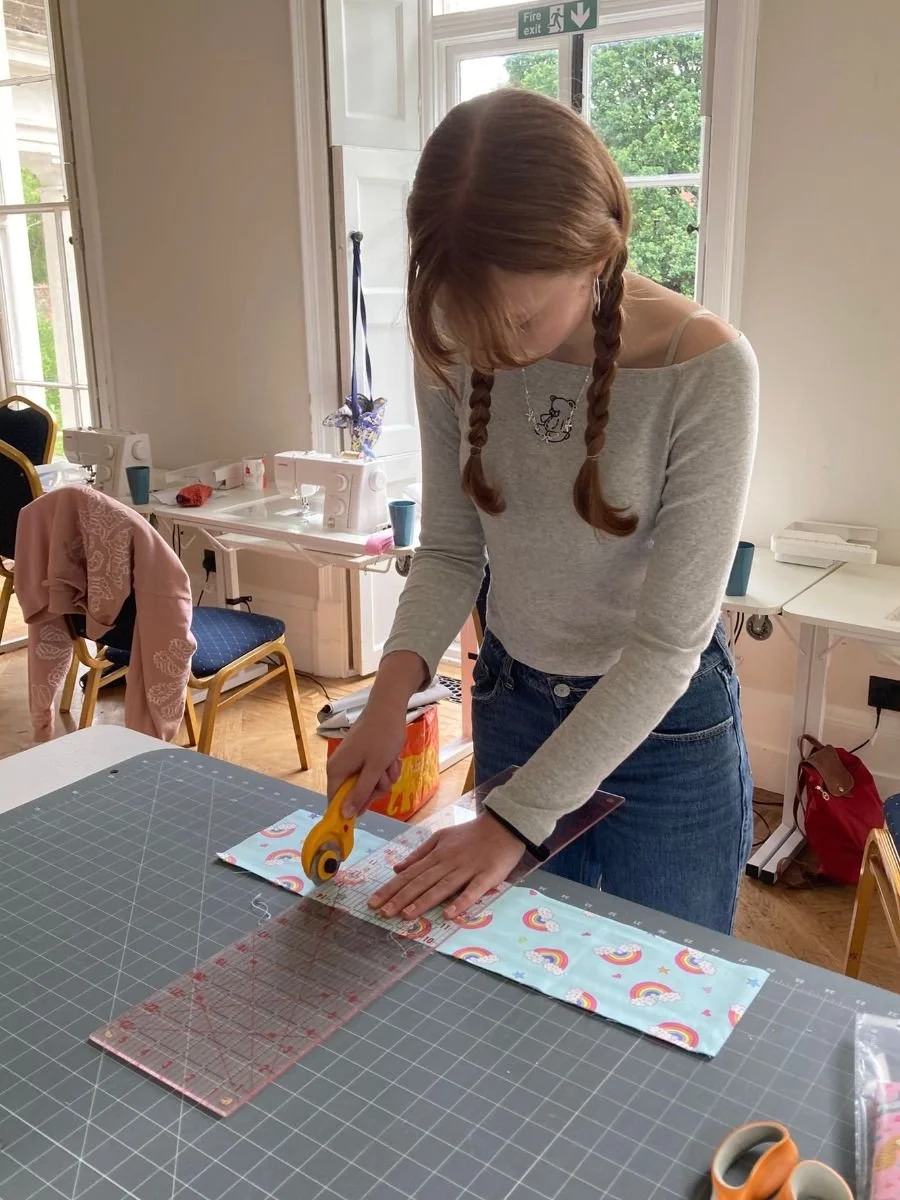
Bell House is not just a place where adults or children learn in isolation. There are many opportunities for families to learn together.
In my case my granddaughter, Agnes came with me to Quilting Academy and made a Linus quilt for King’s College Hospital. She was doing this to complete the skills component of the Duke of Edinburgh Award. Other opportunities exist to complete the volunteering component in both quilting and gardening. Teenagers relax more quickly if they are accompanied by a parent /guardian or grandparent and able to focus on the job in hand.
Besides my grand daughter’s confidence and skills developing, there were other spin-offs. A small cue is all that is needed to share memories and enjoy a trip down memory lane together. In my case 1953 was on the jacket reviews of her set book from her school which was in her bag. I told her all about the Coronation of Queen Elizabeth II and how many people bought televisions especially for the occasion and invited all their neighbours in to watch it. Another quilter came into the conversation and mentioned that was also the year that Sir Edmund Hillary conquered Everest.
Agnes couldn’t believe that our memory was so vivid, as she worked it out that I was only six! Little did she realise how few distractions we had in those days!
So Bell House can create a space not just for inter-generational learning and confidence building but a platform for those precious moments when children discover life can be quite different.
Just in case you missed the recent BBC DIY SOS programme where the wonderful quilt produced by Bell House Quilters was featured, do check out this link.
“Bell House Gardeners - illustrating why Accessibility and Climate Resistance must work hand-in-hand.”
by Gaynor Hayburn and Sarah Hammond. Image Sara Lloyd
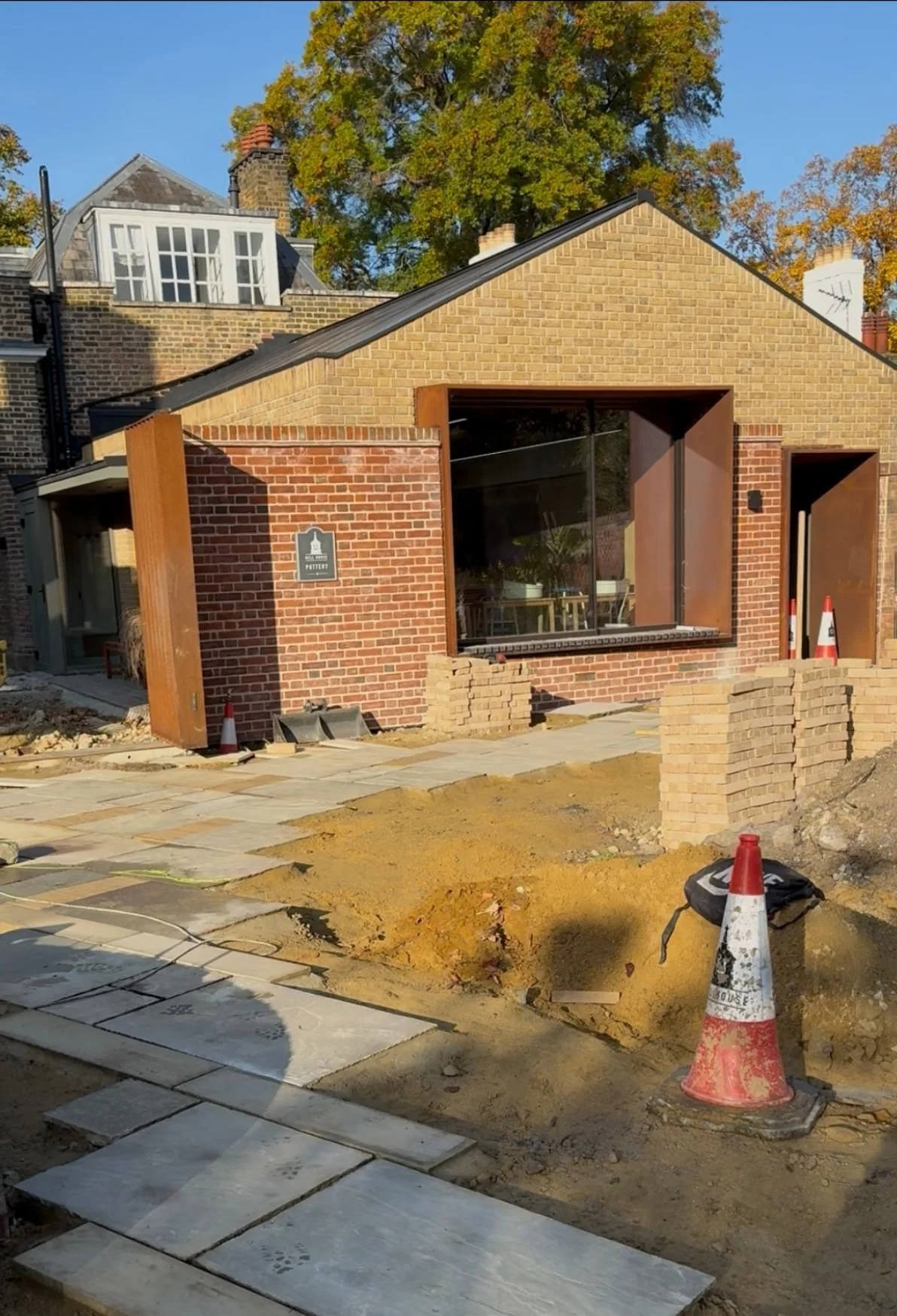
The Bell House gardeners are improving the entrance to the Pottery and Bell House gardens, creating accessible paths into and through the Walled Garden and onto the terrace behind the house. This new space has been designed for sustainability and inclusivity, offering visitors a welcoming and educational experience. The garden will allow us to plant drought-tolerant species and create habitats we don’t have elsewhere in the garden.
We worked with Ben West and his team at Landscaping Solutions and used as many recycled materials, or those salvaged from other projects, as we could. The landscaping is now complete, waiting for planting in early spring and a finishing gravel mulch layer.
To make the paths step free, we needed to raise the ground level across the garden. By using a free-draining substrate layered with sand and gravel on top we were able to create what will be a dry gravel garden. This means we can experiment with more Mediterranean style planting, plants which are drought-tolerant in the summer but struggle with our cold, wet, clay soil in winter. The sand and rubble will require plants which tolerate alkaline conditions, so will introduce more variety into the garden. In the garden as a whole we aim to have a good mix of native plants for specialist pollinators, feeders and their habitats and non-natives to extend the flowering season, providing forage for insects lulled out of hibernation by warmer seasons.
Planting into low-fertility sand and gravel will mean slower growing plants which are sturdier and last longer. Our planting design draws inspiration from the Horniman Museum Gardens, Sissinghurst Delos garden, Beth Chatto’s gravel garden and John Little’s garden in Essex and the Knepp Castle Walled Garden, all of which showcase climate-resilient planting, sand, gravel and reclaimed materials such as crushed concrete and rock.
Different surface materials will enrich the ecological value of the garden with mounds of sand for ground-nesting bees and solitary wasps, areas of open gravel for ground-hunting spiders and rocks and stones for butterflies to bask on. Logs and planting around the raised pond will create habitats for over-wintering frogs and egg-laying opportunities for damselflies and hawker dragonflies.
The new garden will welcome human visitors too with level paths, a new terrace outside the pottery, benches and the opportunity to learn about and explore with us the value of a range of growing conditions and habitats for our flora and local fauna. The garden is open to visitors on the first Saturday of the month, please see the Bell House website for details.
A Celebration of Creativity’s Power to Heal, Connect and Transform Lives
by Sarah Wetherall and Fabienne Hanton
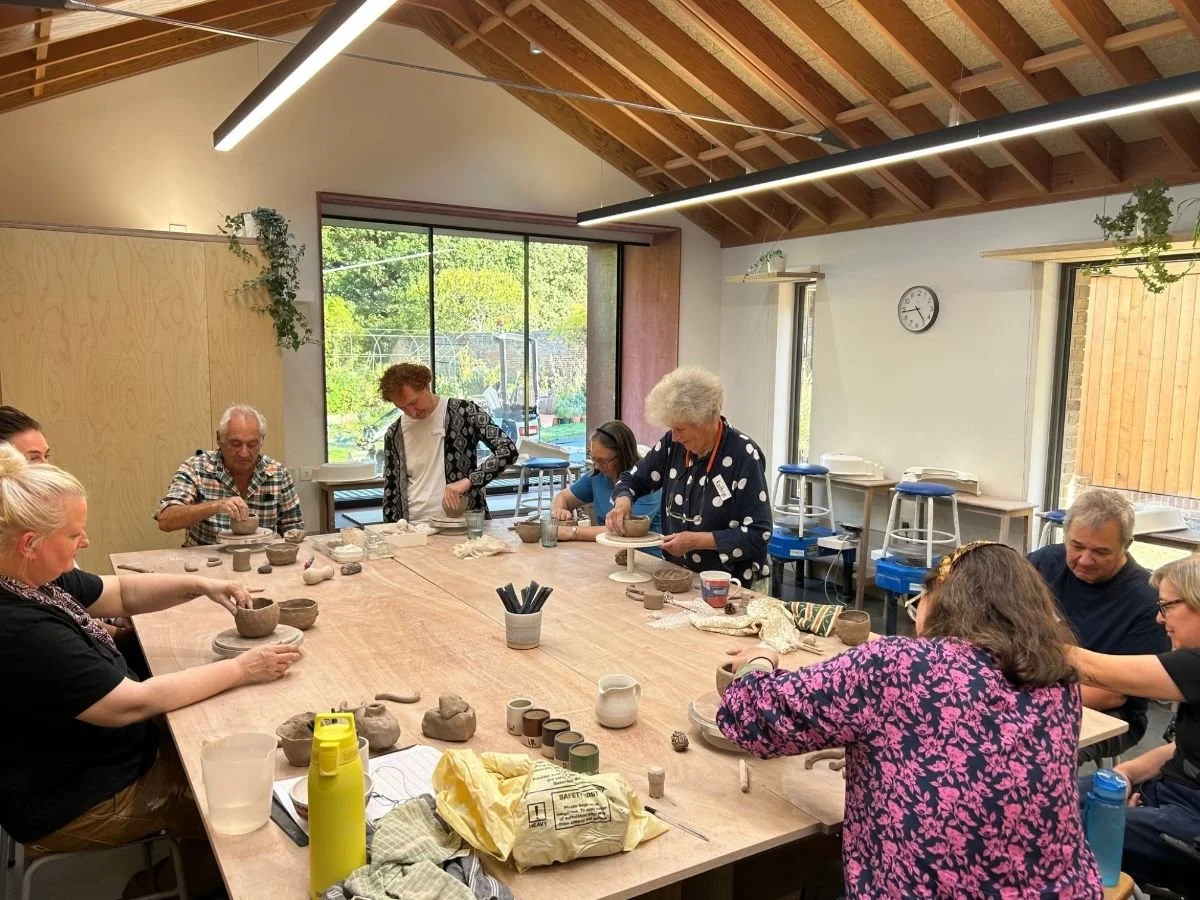
The Bell House Creative Health Project is bringing creativity and care together in a new and inspiring way.
It was launched earlier this year and explores how art can enhance wellbeing and bring people together. By partnering with local health charities, artists, and community organisations, the project is using creativity as a powerful tool to support both physical and mental health.
The first charity to partner with the project this year was Aphasia Re-connect. Over 350,000 people in the UK are affected by Aphasia which is a communication disability and occurs when the communications centres of the brain are damaged from for example, a stroke, brain injury, tumour or hemorrhage and can impact on your ability to read, write or speak.
So far, members of this group have been welcomed to Bell House to take part in a marbling class and a pottery class.
At the marbling class Sarah showed participants how to work ink onto the surface of water, to make patterns for transfer onto plain paper. Each pattern is unique and every participant made 8 beautiful marbled papers to take home.
At the pottery Gaby showed members of the group how to make a simple cup, a bowl and a jug and everyone was given the choice of making two of the three pieces. The finished items were left on site to be fired before being returned to the participants.
In both classes the artist practitioners and participants had wonderful support from two speech and language therapists, Rachel Ba and Katherine Preece as well as in-house volunteers Jane, Jenny, Paula and Jim.
And for the participants an added bonus was the beautiful Bell House and garden setting for these workshops. The time to break for refreshments, enjoy the surroundings and talk together is an essential part of the experience at Bell House and everyone was able to sit outside and enjoy the sun, which obligingly shone for both workshops. We had great and constructive feedback from participants for both the activities.
Through hands-on workshops in painting, pottery, music, and stitching, participants are discovering how creative expression can boost confidence, reduce stress, and build connections. Each session is designed to be inclusive and accessible, encouraging everyone to take part, explore their creativity, and leave with a sense of achievement and belonging. Health charity partners help shape the programme, ensuring that activities draw on therapeutic practices and align with evidence-based approaches to wellbeing. This collaboration strengthens the impact of each workshop.
As the project grows, so does our belief that active engagement with the arts and creativity can be beneficial for our health and wellbeing.
The Bell House Creative Health Project is a celebration of creativity’s power to heal, connect, and transform lives. We have great plans for 2026.
Introducing Liam Sherriff - Bell House’s Inaugural Filmmaker-in Residence
by Liam Sherriff
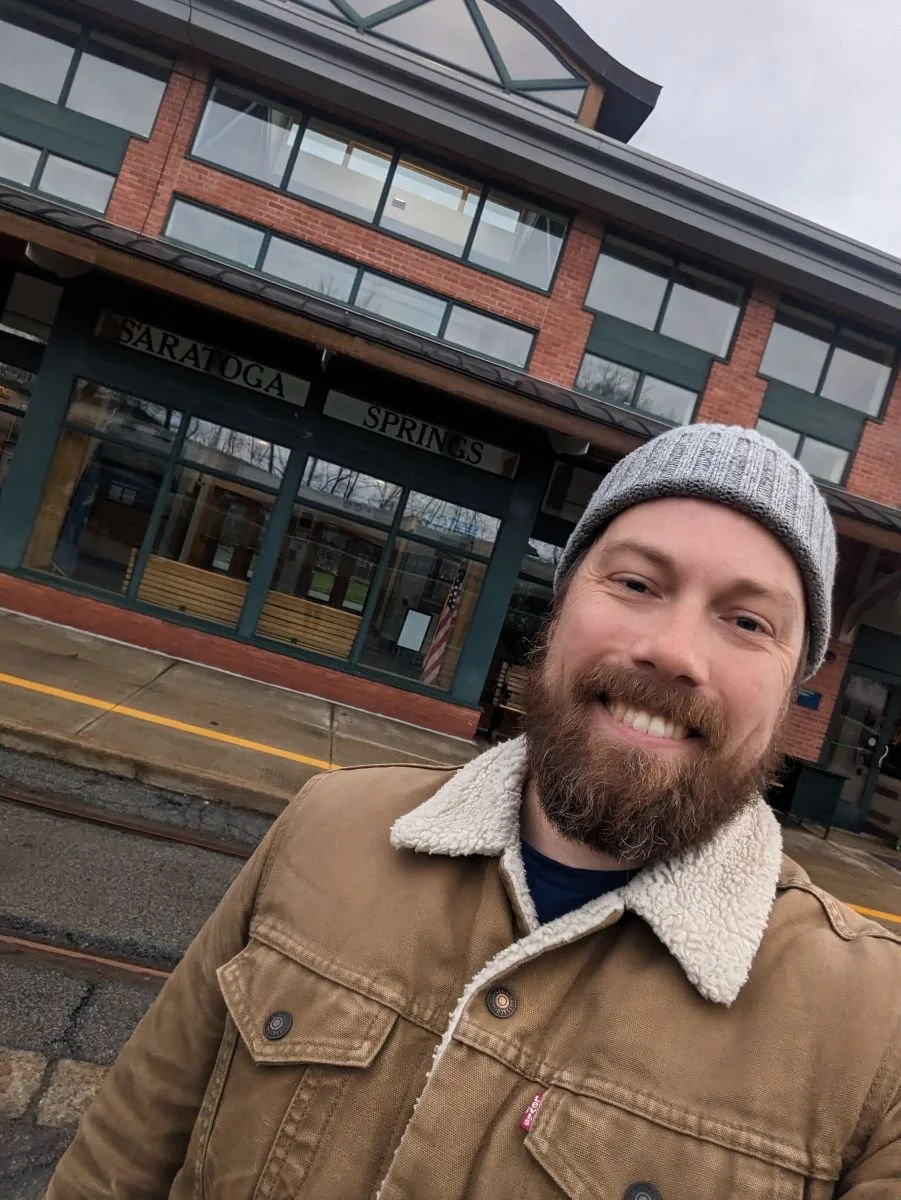
I am very excited to be the inaugural filmmaker-in-residence for Bell House. As with many other things in life, I arrived here via a circuitous route and with the help of many friends.
In the summer of 2025 I had just finished work back in Canada on my third feature documentary in a row and was looking to shake things up a little and expand my horizons. Through the great network of filmmakers I'm lucky to be a part of, I met Morgan - also an English/Canada based filmmaker - who was looking for someone to take on this role. Given both my professional and academic background, and my need for a project on arriving in London, it was a great fit.
I am primarily a feature documentary editor, both picture and story. I also have an academic background in literature and film, and professional experience working for non-profits and charities back in Canada, where I live on the west coast. I’ve enjoyed working on all genres of film and television from animation to webseries, but long-form nonfiction is where I do my best work. The last three documentaries I was a picture and/or story editor on include the biography of famous physician and writer Gabor Mate, the story of Canada’s largest act of civil disobedience, and the ongoing saga of the war on (and for) drugs in Vancouver, British Columbia.
My overall aim during my time here is to set up future filmmakers for success at Bell House. Current projects I'm working on include obtaining a professional camera and microphone for the house. This could be used for capturing the events and activities of the house - including recording talks and lectures - as well as more creative pursuits for future artists-in-residence, or classes and workshops. To that final point I am currently developing a short documentary class for local youth; look for that in the early spring! Finally I am also instituting a film club, starting with a screening of Physician Heal Thyself: the life and work of Gabor Mate. The film offers a searingly intimate portrait of the celebrated expert on addiction, stress and trauma. It’s showing on Wednesday 10th December at 7.00pm at Bell House. https://www.tickettailor.com/events/bellhouse/1964554
Whilst all that is ongoing I am also keeping my ear to the ground and my eyes open for interesting new stories to tell about the people in the community.
Do you or a family member have a unique passion or goal?
Is there something different about how you live your life?
As long as it’s authentic, the universal can always be found in the specific, and the smaller stories are always truly more interesting. A good story can often be found in someone who pursues an interest or desire that’s just a little outside the mean.
Please reach out to me - I’m always looking for more subjects for micro-documentaries. [email protected]